jeudi 31 mars 2011

HOW TO: Get the Most Out of Advanced Social Media Search

According to Mashable; HOW TO: Get the Most Out of Advanced Social Media Search

search image

Ann Smarty is a search marketer and full-time web entrepreneur. Ann blogs on search and social media tools. Her newest project, My Blog Guest, is a free platform for guest bloggers and blog owners. Follow Ann on Twitter at @seosmarty.

Social media search ? the ability to tap into thousands of real-time updates ? has long been a hot topic. It opens up endless opportunities for market and competitor research, content inspiration and, obviously, network building.

In this post, we?ll aim to tackle some more advanced social search functionality so that you can make the most out of Facebook, Twitter and LinkedIn.


Twitter


Background information

Twitter search can be accessed from your Twitter home page, as well as from a separate subdomain. Twitter search focuses on real-time results; however, Twitter has introduced important algorithm changes that push particularly hot and ?promoted? tweets above the real-time results.

Advanced search:

The official Twitter search is a powerful tool. From there (as well as by using search operators) you can:

  • Adjust your query (exclude any word/force any word/force the exact match, etc.).
  • Set the language of search results.
  • Filter search results by user name (to see tweets from a user or mentioning some user).
  • Set the local filter (to see tweets near a location).
  • Play with emotional coloring (using the smile emoticons) as well as search for tweeted questions.
  • Include or exclude retweets.
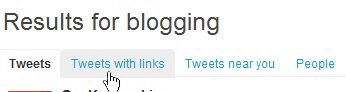
  • Restrict results to those containing links.

While the above options are certainly effective, the most useful one is hidden.

Twitter Advanced Search Operator: Filter Out Links

Show tweets with links

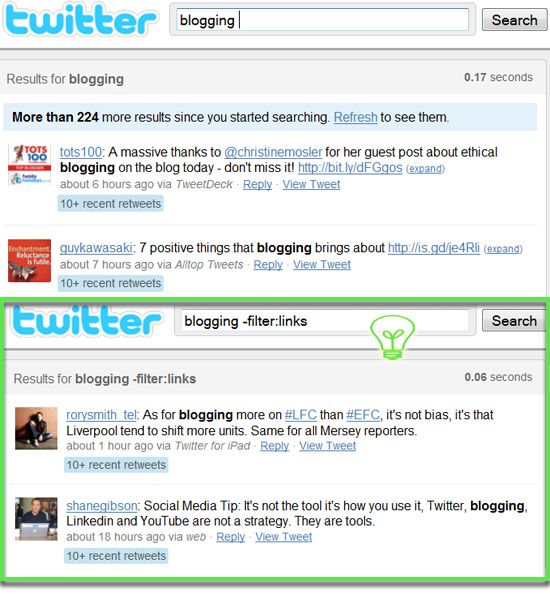
Both Twitter Advanced Search and twitter.com/search offer easy ways to only show tweets that contain links. However, because most tweets already contain links, in many cases the searchers are most likely to look for the opposite: a way to see tweets that have no links in order to filter out numerous updates around the same popular URL. This option is invaluable for real Twitter conversations.

To filter out all tweets containing links, you need to use -filter:links operator within your search query. The minus sign is crucial:

-filter:links

As you can see, it can be a handy way to find great quotes, sincere opinions, reviews and discussions.


Facebook


Background information:

Facebook advanced search

Before we get into detail, let?s make it clear what exactly we are talking about here. Facebook has three huge search platforms. We are interested in two of them:

Advanced search

The only way you can filter results is by type: People, Pages, Groups, Apps, Events, Web Results (powered by Bing), updates from friends or any update made public.

Limitations

It?s important to remember some things about Facebook search:

  • It is unpredictable. Facebook search relies heavily on your friends and friends of your friends, so you never know what other users see for your search query. It?s like Google personalized search, but with a stronger reliance on social connections over any other ranking factors.
  • It relies on exact match and lacks advanced operators (and thus flexibility). Unlike Twitter search, Facebook gives you no freedom with your query. You can?t exclude one word while including another one. You can?t filter results by location and so forth.
    • People: Filter results by location, relationship, (past) industry and school. More options are available for premium members.
    • Updates: Filter results by your connection level, see updates from your immediate network, from friends of your friends or your third-level network, as well as set the time range, location, etc.
    • Jobs: Filter results by how fresh they are, experience required, industry, etc.
    • Companies: Filter results by location, industry, relation, company size, fortune, etc.
    • Answers: Filter by categories. You can add multiple categories.
    • Groups: Filter by category and language.
  • Facebook Advanced Search Operator

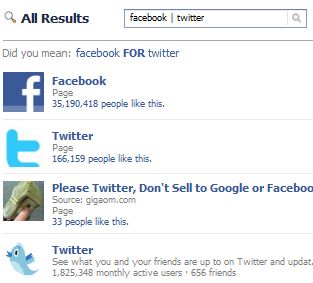
    Facebook search relies too much on exact matches. For any two words, you will only see results that contain both of your terms. But what if I want to see combined results for two words used in the query? Luckily, there?s a hidden operator. For example, twitter | facebook search will trigger results containing either ?twitter? or ?facebook? (or both):

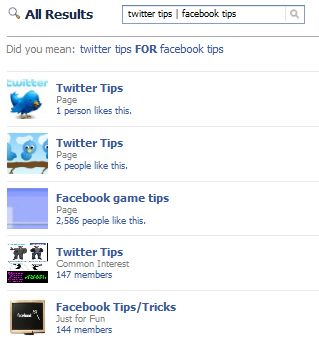
    Advanced search facebookTwitter tips | facebook tips will list either ?twitter tips? or ?facebook tips? (or both):

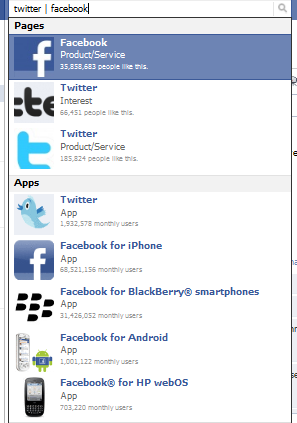
    Facebook advanced searchThe same operator works for the auto-complete drop-down, which means you can see much more varied results there as well:

    Facebook Advanced operatorThis supported operator gives at least some freedom in controlling your search results? proximity and variety. Let?s hope Facebook will eventually come up with more.


    LinkedIn


    Background Information

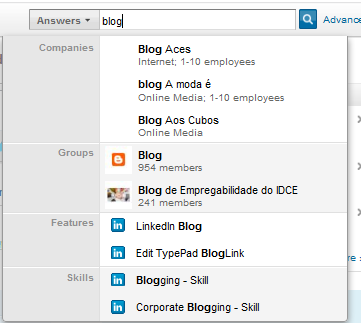
    LinkedIn has a well-developed search platform that is broken into six independent sections: People, Updates, Jobs, Companies, Answers and Groups. All of these sections offer mixed suggestions (possible results from several sections) as you type.

    Linkedin Search suggestions

    Advanced search

    Each of the above sections has a huge range of advanced search options, listed below:

    With such a variety of options, you are unlikely to ever need any more of them. However, there are some really handy Boolean operators, which can make search even more efficient.

    LinkedIn Search Boolean Operators

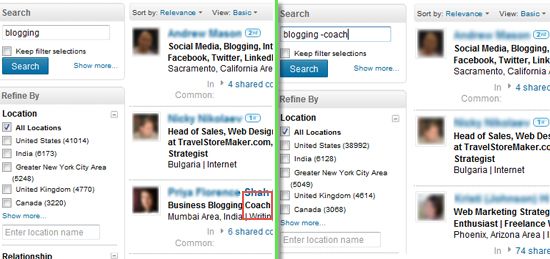
    Exclude any term while staying within your topic. For example: blogging -coach. Compare the results below:

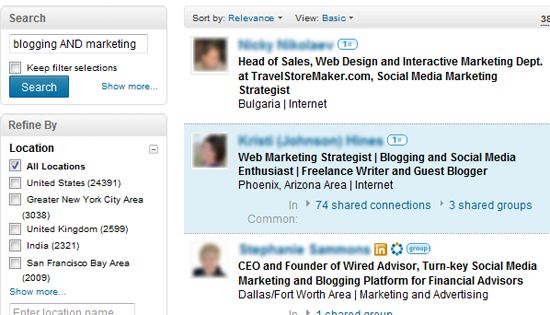
    Linkedin - exclude any word from search resultsCombine two search terms within one search if you, for example, want to find people who mention both ?blogging? and ?marketing? in their profiles:

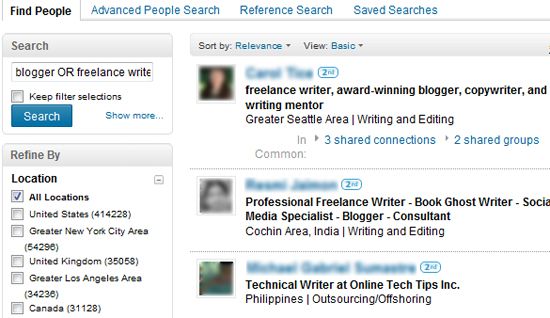
    Combine search terms - LinkedinChoose to see at least one of your terms within search results. This one is similar to Facebook?s operator mentioned above. For instance, search for blogger OR freelance writer:

    LinkedIn search: OR operator


Square One a Dallas Digital Agency are experts in social media optimization.

    Tags: ,


    Source: http://www.sq1agency.com/blog/?p=2607

    Taylor Swift Tiger Woods Tina Fey Toby Keith

    Official: Google launches a new anti-spam algorithm against content farms

    Back to our newsletter archive

    Welcome to the latest issue of the Search Engine Facts newsletter.

    Earlier this month, Google announced that they would release several new anti-spam algorithms this year. The first algorithm update has just been released and it deals with content farms. How does this affect your website and what do you have to change on your web pages?

    Also in the news: some content farm providers claim to have arrangements with Google, local and mobile advertising becomes more important, Google deletes ads in Google Maps and more.

    Table of contents:

    We hope that you enjoy this newsletter and that it helps you to get more out of your website. Please pass this newsletter on to your friends.

    Best regards,
    Andre Voget, Johannes Selbach, Axandra CEO

    Earlier this month, Google announced that they will release several new anti-spam algorithms this year. The first algorithm update has just been released and it deals with content farms.

    What are content farms?

    There are two slightly different definitions of content farms:

    1. Content farms are scraper sites that aggregate the content from other sources to get high rankings for a variety of long tail keywords. These sites don't have unique content and they only aggregate the content from other websites to get clicks on their AdSense ads.

    2. Content farms are websites that produce low quality content in bulk. This content is often produced by workers from low-wage countries. The main purpose of these sites is to get high rankings for as many keywords as possible to get clicks on the AdSense ads that are displayed on the site.

    Sites that copy the content from other websites often ranked higher than the original site in Google's previous algorithm. That's why Google released the algorithm update.

    Google's Matt Cutts confirmed the new algorithm:

    "[I mentioned] that 'we're evaluating multiple changes that should help drive spam levels even lower, including one change that primarily affects sites that copy others' content and sites with low levels of original content.'

    That change was approved at our weekly quality launch meeting last Thursday and launched earlier this week."

    Less than 0.5% of search queries have significantly different results

    Matt Cutts also said that most surfers won't notice the change:

    "This was a pretty targeted launch: slightly over 2% of queries change in some way, but less than half a percent of search results change enough that someone might really notice.

    The net effect is that searchers are more likely to see the sites that wrote the original content rather than a site that scraped or copied the original site's content."

    The algorithm doesn't seem to be perfect yet

    In an online discussion, many webmasters complained that their original sites have suffered while low quality sites still rank well:

    "It doesn't matter if it is all 100% unique with tons of backlinks and really well laid out or simply an image. Everything got whacked.

    Our out of date non unique ad filled sites are humming along FINE. So what's the message here Google? Write an in depth article that takes 3 days to complete and is linked to by hundreds of companies and gov agencies and loose all positions sitewide while our out of date halfbaked and useless content does fine?"

    Should you change your web pages?

    Google doesn't like spam. If you want to get lasting rankings on Google, you have to do three things:

    Spammy SEO techniques often deliver quick results but they only work for a short time:

    If you plan to build a lasting online business, focus on ethical search engine optimization methods. It takes longer to get high rankings with ethical SEO methods but your website will keep the high rankings for a much longer time:

    The content farm algorithm update was only the first step. Google will release many more anti-spam algorithms this year. If you want to be successful with your website, you must make sure that you offer a useful site and that you offer Google the content that they want.

    Back to table of contents - Visit Axandra.com

    Google's John Mueller: what to do if your website has been downranked

    In an online discussion, Google's John Mueller says what you can do if your website has been downranked after Google's latest algorithm update:

    "One thing that is very important to our users (and algorithms) is high-quality, unique and compelling content. Looking through that site, I have a hard time finding content that is only available on the site itself.

    If you do have such high-quality, unique and compelling content, I'd recommend separating it from the auto-generated rest of the site, and making sure that the auto-generated part is blocked from crawling and indexing, so that search engines can focus on what makes your site unique and valuable to users world-wide. "


    DemandWhat are Demand Media's secret ?agreements? with Google?

    "For those of you that haven't heard of the company they are a content farm using outsourced writers to produce 5000 articles per day on sites such as eHow and various other informational resources. [...]

    Google declared war on 'content farms' last week but refused to comment on Demand Media specifically. [...] I certainly won't be buying shares in Demand Media anytime soon, unless they can let us have a look at that agreement with Google perhaps."

    Google: local and mobile advertising becomes more important

    "In Local, over 5 million businesses have claimed their Google place pages. [...]

    Click-to-Call ads are generating millions of calls every month. A lot of advertisers are running these campaigns. I think one you can see if you tried is DirectTV. We did launch a call-only option where the only clickable link in the ad is actually a phone number, which not surprisingly substantially increases the click through rates on mobile devices."


    Google Local Google drops real estate search listings

    "In part due to low usage, the proliferation of excellent property-search tools on real estate websites, and the infrastructure challenge posed by the impending retirement of the Google Base API (used by listing providers to submit listings), we've decided to discontinue the real estate feature within Google Maps on February 10, 2011."

    Google's Schmidt wants to set the record straight

    "Eric Schmidt opens up about his company's executive shuffle, whether or not Facebook poses a threat, and where Google is competing with Apple. [...]

    This has nothing to do with competitors. I publicly said the next 10 years will be as successful as the past 10. We're going to run this way for a while. It's a full-time job just to deal with."

    Search engine newslets

    • Rumor: Twitter self-serve ad platform coming next year.
    • Google to acquire fflick for $10 million.
    • Google adds snow conditions results and improved weather forecasts for mobile.
    • Has Larry Page doomed Google? Larry Page's Google 3.0.
    • Ed Vaizey hears MP's concerns over Google monopoly.
    • Bing feature update: compare travel destinations.
    • Google executive missing after Egypt protests.

    Back to table of contents - Visit Axandra.com

    300,000 readers will read your success story!

    Let us know how IBP has helped you to improve your website and we might publish your success story with a link to your website in this newsletter. The more detailed your story is, the better. Click here to tell us your story.

    Here's an example:

    "We now have several page 1 entries in Google, Bing and Yahoo!"

    "We have been using IBP since launching our site. It has proved to be successful for us. We now have several page 1 entries in Google and Yahoo.

    In fact we have the number one slot on Yahoo for one of our main key phrases. We found all of the software very useful, particularly the ranking tools, the optimizing section and the submission pages.

    We started out looking at our competition and seeing the comparison to our site through the optimizer with the top 10 report. This was able to show how much we differed from the sites above us and offered recommendations to improve our position.

    Once we put as much as we could into practice, the results started to come. Now we keep an eye on our positions in the search engines using the ranking checker. It enables you to see your improvements and any downward movements. We can recommend this software."
    Steve Sewell, www.PerfectFloridaVillas.com

    Back to table of contents - Visit Axandra.com

    Back to table of contents - Visit Axandra.com

    The Search Engine Facts newsletter is free. Please recommend it to someone you know.

    You may publish one of the articles above on your Web site. However, you must not change the contents in any way. Also, you must keep all links and you must add the following two lines with a link to www.Axandra.com: "Copyright by Axandra.com. Web site promotion software."

    All product names, copyrights and trademarks mentioned in this newsletter are owned by their respective trademark and copyright holders.

    Back issues:
    http://www.free-seo-news.com

    Back to our newsletter archive RSS feed for weekly search engine ranking facts

    Source: http://feedproxy.google.com/~r/free-seo-news/cXWx/~3/ADhUag83SCg/newsletter458.htm

    Jerry Seinfeld Jessica Alba Jessica Biel Johnny Depp

    lundi 28 mars 2011

    Great ways to get an interview in SEM, SEO and/or Analytics

    Since I spend my days looking at resumes and cover letters (I had four open positions, but am finally starting to figure some of them out), I wanted to write what the job search looks like from the other side, especially when it comes to our field, Internet Marketing.

    Now, some of you have it great. You?ve got amazing credentials and can write your own ticket.� But there is a big group of people who just want to get into the field.

    IMO, the hardest part is getting to the interview. Once you are there, you have the opportunity to wow the company with how great you are. But until you get into the door, you are just another piece of paper. So here are some ideas:

    Network. Not an exceptionally exciting or new idea, but it is surprising how well it works and how few people take advantage of it. The first person I ever hired at LunaMetrics came to me through an intermediary whom I trusted.� Note, I had already chosen (in my mind) the ?successful candidate? and I threw all that thinking out the door when my friend suggested this potential.� And how about going to all those Web Analytics Wednesdays, or attending local SEMPO events? In our fair city alone, there are three competitive SEO groups where you can network.

    Research. If you are really interested in a job, go read that company?s website. Follow their employees on Twitter ? after all, you are an Internet person, right?. They would probably love to hear from you on their FB page.� Understand who they are before you approach them for a job, because otherwise, you are just another piece of paper.

    Get experience. Yes I know, it is hard to get experience without experience. On the other hand, there are a lot of websites that need your tender loving care, go get experience with them. Look into summer internships.� What about accreditation ? the AdWords badge requires that you manage a certain amount of money over a certain amount of time, but anyone who has fifty bucks and can study can take the GAIQ test.� Without experience, your piece of paper is too easy to screen out.

    Decide what you want to do.� I see so many resumes where people say, I am the webmaster and I do SEM and then SEO and GA and social media and and and. It is lovely to be flexible (and very necessary in a small company like ours), but when I am looking for an SEO expert, I probably don?t look to someone who does a little bit of everything. (Go ahead and disagree.)

    Stop blathering about how great you are and start showing how great you are. I must get one resume every day that says, ?I am uniquely qualified for this job.?� I?d love to get a cover letter that says, ?I?m interested in your company and the job, I think I have the right experience and qualifications, but I do have a number of questions.?� After all, in this most interactive of all worlds, why should the job search be so one way?

    Be creative. Although we don?t do graphic design, I did find this great graphic design resume in the Creative Commons part of Flickr, at the top of the page.� How cool is that?

    Robbin

    Related Posts

    1. My eMetrics Summit "pre-interview"
    2. My Interview with Eric Peterson
    3. Twenty five ways to increase your online conversion rate
    4. eMetrics Summit: Great Networking
    5. Conversion: Great Thank You pages, Part II

    2 Responses to ?Great ways to get an interview in SEM, SEO and/or Analytics?

    Great Article Robbin! I wanted to add one more idea. Volunteer. We had a guy come in to apply for a job earlier this week and he really stood out from the rest of the applicants, because he was already doing SEO for free for a church. There are many organizations out there that don?t have the money to do SEO or Analytics, but would appreciate someone who could volunteer to do it for them. This is a great way to get a good letter of recommendation as well.

    Thank you very much for this useful post. I appriciate for helping noobs.

    Leave a Reply

    Source: http://feedproxy.google.com/~r/lunametrics-blog/~3/oklrhQuHi68/

    Meryl Streep Michael Bay Michael Jordan Mila Kunis

    I'm Ranking, So Where's My Traffic?!

    It's an old story ? Boy meets Girl, Girl promises top rankings, rankings finally arrive, and Boy suddenly realizes he has no traffic. Wait, that's not quite it. Replace "Girl" with "SEO company" and "Boy" with "client" - yeah, there we go. In SEO, nothing is quite as frustrating as pouring time and money into your chosen keyword and finally breaking into the Top 10, only to find that you still have no visitors.

    There are a number of possible causes for ranking without traffic - I'm going to divide them up into 3 groups:

    1. You're Not Really Ranking
    2. Your Keywords Don't Deliver
    3. Your Results Don't Get Clicked

    Isolating the problem is the best first step toward a solution and to making sure that your SEO efforts haven't been wasted.

    (1) You're Not Really Ranking

    Now that search results are increasingly being personalized, localized, saturated with ads, and otherwise moving away from the idea of one SERP for everyone, the most common issue with rankings not delivering is that everyone else isn't seeing what you're seeing. It's great for the ego to see yourself in the #1 spot, but it's not good for much more than ego if that ranking is an illusion. Here are a few reasons your ranking may not be what you think it is:

    Your Rankings Are Personalized

    Although personalization still only impacts a small amount of search results, it's always smart to do a sanity check. Unfortunately, shutting off personalization isn't as easy or reliable as it used to be, but there are a few steps you can take:

    • Log out of your Google account
    • Use the "&pws=0" parameter to shut off (some) personalization
    • Use a different browser (that you don't normally use)
    • Use a 3rd-party rank-tracker, like our own Web App or Rank Tracker

    Your Rankings Are Localized

    Technically, you could call this a form of personalization, but the local SEO portion of the algorithm is definitely a unique beast. If you have any business that's locally operated or where the search query has a local flavor, make sure to check that you're ranking outside of your region.

    There are a couple of ways to sanity-check your local results. One is to tell Google you're somewhere else, using the "Change Location" feature on the left of search results:

    Google Choose Location option

    Another option is on the analytics side. If your search traffic isn't up to your expectations, try segmenting it by country or city (as appropriate) to see what's really going on. For example, in Google Analytics, once you've selected your desired search traffic data, click on the second dimension pulldown (it should say "None"), select "Geographic", and you'll get a full list of options, including City:

    Google Analytics geographic analysis

    Of course, internationalization can also come into play. If you did your keyword research against Google.com, but you're only ranking on Google.be (sorry, Belgium), then you've probably overestimated the size of your target market.

    Your Results Are Crowded Out

    The days of the 10-listing SERP are gone, and there's an increasing issue on Google and Bing where the prevalence of paid search, local search, image results, video results, real-time results, news results, and other listings outside of the top 10 means that "pure" organic listings can be all but crowded out. Consider this sample search for "pizza place" here in my home-town of Chicago:

    Google "pizza place" results

    The purple line represents the "fold" on my 1280x1024 screen setting. Notice where the top 3 organic results are? If you're not ranking locally on this SERP, you've got nothing.

    (2) Your Keywords Don't Deliver

    The next most likely culprit is that you just didn't do your keyword research very well, or those numbers turned out not to be very reliable. There are a couple of variations of this problem:

    Your Keyword Volume Is Low

    Assuming you did your homework, the unfortunate truth is that most keyword research tools rely on Google's numbers, and Google's numbers aren't always accurate, especially as you dive into the long tail. Even worse, the numbers can say different things depending on how you slice and dice them.

    For example, I have a site that ranks pretty well for "website checklist". If I looked at Google's numbers, I'd see 8,100 total monthly searches (global). Most of this is broad-match, though ? looking at exact-match cuts that to less than 10% of the traffic:

    Google keyword tool screen

    So, if I had expected ranking on this exact phrase to be a traffic boon, I might've been disappointed. Many more people are searching for variants or longer-tail phrases that contain those keywords.

    Your Keyword Doesn't Match Intent

    This issue cuts a bit into section (3) below, but I consider it first and foremost a keyword-research problem. Let's say that, by some miracle, you manage to rank in the Top 3 for "apple" and that you're an online store that sells bulk fruit. While some people who query "apple" may be looking to buy apples, most of them are looking for Apple the company, Apple products, Apple Vacations, etc. If that ranking "victory" had cost you thousands (or millions) of dollars, you wouldn't feel so victorious when no one searching that phrase actually wanted to buy apples. You could've done a lot more for less with some action-oriented 2-word and 3-word phrases (like "buy apples online").

    (3) Your Results Don't Get Clicked

    Finally, it's important to remember that ranking is just the first part of getting search traffic. People have to actually click on your search listing. It's traditionally tough to get click-through data on organic SERPs, other than relying on gross stats on CTR by ranking. Fortunately, Google Webmaster Tools is starting to provide more of that data (under "Your site on the web" > "Search queries"):

    Google Webmaster Tools CTR data

    So, what could make an otherwise perfectly good search result unclickable? There are a couple of major culprits (in addition to the searcher intent issue mentioned earlier):

    Your Listing Just Looks Spammy

    You've tried so hard to rank, that you forgot about the human element, and you ended up with a search results that looks something like this (generated with the Snippet Optimization Tool):

    Fake search snippet

    Would you click on that? Ranking is only half the battle.

    Your Competitors Are Winning

    This is a topic that gets discussed much more on the PPC side, but sometimes you're just getting outclassed. Maybe you're ranking, but the rest of the Top 10 is being dominated by big brands, great copywriting, great offers, etc. Make sure to know what you're up against.

    Similarly, be aware of any ORM issues. For example, let's say you rank #1 for your chosen keyword, but the #2 spot is "Your Brand Scam" or something to that effect. Even if that listing is below you, it's going to make people think twice about your company and your link. Search rankings aren't isolated and people make decisions based on cues from the rest of the SERP.

    So, Now What Do You Do?

    While it's good to be aware of these issues, ranking without getting the traffic you expected isn't usually a lost cause. It's time to regroup, dig deep, and really find out why the numbers don't match up. You may learn a lesson in where your real audience is and what they're searching for, and you can use that to improve your overall SEO strategy. In many cases, ranking for one term is going to boost your chances to rank for related terms (you've still got good content and links), so you may just need a slight shift in strategy. Figure out exactly what went wrong, and take it as a learning experience.

    Source: http://feedproxy.google.com/~r/seomoz/~3/wdQIYCYGQZM/im-ranking-wheres-my-traffic

    James Patterson Jay Leno Jay-Z Jeff Dunham

    dimanche 27 mars 2011

    Code For America

    If you don?t already know about Code For America, I highly recommend you read about the initiative. As a web geek myself, I find it to be an incredible program and see it as an essential part of advancing this technology that literally has changed the world.�Below is an article�originally published by Jolie O?Dell on Mashable. It?s a great description of the CFA Fellowship Program.


    Code For America Calls For Hackers With Hearts of Gold for 2012 Fellowships


    Code For America seeking devs for its 2012 Fellowship Program, a year of public service that puts coders to work for communities.

    The fellowship gives developers, researchers, entrepreneurs and designers a chance to build customized web and mobile apps for communities and governments. Their work is used to solve pervasive public problems and connect citizens to governments. Each app built will be open sourced, as well.

    The 2012 fellowship will be the second annual program of its kind. This year, recent graduates are encouraged to file early decision applications, which would allow for better planning of internships, employment or continued education. Those applicants would be notified of CfA?s decision by May 1, 2011.

    Early decision applications are due April 15, 2011, and all other applications are due August 1, 2011. Would-be fellows can�apply now on Code for America?s website.

    Last year, the fellowship program had room for�20 fellows, and more than 350 applications were received. Given the�stature of government applicants for the second cycle, competition is expected to be even more fierce this year.

    Fellows in the year-long program will receive a living-wage stipend, travel expenses and healthcare. They?ll also get leadership training, networking opportunities and future career support in the form of guaranteed interviews at top web companies.

    Square One a Dallas Digital Agency are experts in Web Development

    Tags:


    Source: http://www.sq1agency.com/blog/?p=2563

    Drew Barrymore Ellen Degeneres Emma Watson Eva Longoria

    Police Guilty of Server Arrest

    February 2nd, 2011 by John

    The Home Office launched a new initiative through www.police.co.uk on February 1, whereby visitors could log onto the site and search for crime statistics in their neighbourhood by entering their postcode. Unsurprisingly, the site crashed within minutes as over four million people tried visiting at once.

    Approximately 75,000 people a minute tried accessing the service as soon as it was launched, leading to bugs, glitches and crashes. The Home Office recognised the problems and urged people to ?keep trying?.

    Sorry Home Office, but that simply doesn?t wash with us. The interest in this project was huge, as underlined by a statement from site developers Rock Kitchen Harris, based in Leicester: ?The site is down at the moment but it is being resolved. It has had a lot of interest, more than we expected due to the high media coverage.?

    The Home Office have launched a new online crime statistics service

    There have also been varying levels of satisfaction in regard to the figures being shown on the website, with some people saying that the figures are a wild, inaccurate view of their street, and that their communities are being misrepresented. That?s a problem for the Home Office to sort out, though. What we want to read the riot act over is the Home Office?s poor planning before the site?s launch.

    Who doesn?t want to know if their street is safe or not? An official crime statistics service from the Home Office was always going to draw massive traffic to the site, and they should have made sure their servers could cope with such volumes. Our advice is always to have good, speedy servers in an SEO campaign to improve the overall user experience. Site speed has also become an important factor for search engine optimization services, but we?re more concerned with the usability aspects of having a good server.

    Link to us

    If you want to link to this blog, copy and paste the following HTML code to your website.

    Leave a Reply

    Source: http://www.searchengineoptimization.co.uk/seo-blog/about-seo/police-guilty-of-server-arrest.html

    Kristen Stewart Lady Gaga Lance Armstrong Lebron James

    So you think SEO is expensive?

    Chatting with a search-marketing expert

    Using a search engine like Google or Yahoo is the most common way customers look for products online. Without effective search engine optimization, your business may get left behind.

    In a chat with SEO expert Dustin Williams, the recently promoted senior SEO analyst offered some tips for those hoping to market their smaller companies to the next level.

    He said that cutting through the cyber-clutter requires your website be near the top of the search results when people search for your product or service online.

    ?You can build a company, but if nobody knows where it is or how to find it, it?s not going to get business,? Williams said.

    Whether you do it yourself or hire an SEO firm, Williams said businesses today cannot afford to not rank highly on the world?s most popular search engines.

    The owners of some businesses probably believe that beefing up their company?s presence online will bust their budgets. If they have any money for marketing, it?s probably a very small amount.

    But over the telephone, an SEO expert can assess which methods might work best for you.

    ?If they contact us, we can really assess their needs,? Williams said. ?We can evaluate their website and we can evaluate the competition.?

    A small startup company might not have the money to pay a major SEO firm, he explained.

    ?There are different companies that provide different services at varying costs,? Williams said.

    But closely scrutinize any SEO firm before hiring them, he stressed.

    ?There are a lot of companies out there that promise results but don?t always get it,? he said. ?You need to do some research.?

    Hiring a professional is the quickest way to provide your business a noticeable presence on the Internet. One sign of a credible SEO firm is that their website ranks highly on Google.

    ?If their website ranks high, that?s a great indicator,? Williams said. ?If you?re searching in Google and you can?t find the SEO company, then they can?t do it for themselves.?

    Also examine a list of the firm?s clients.

    Meanwhile, businesses with time on their hands may try themselves to improve their presence online.

    ?SEO takes a while to learn to the point where you do it effectively,? Williams said. ?Time is money.?

    Generating leads among people who are genuinely interested in your product takes patience and persistence. And staying up to speed on the most current SEO trends is critical.

    More important, however, is having strong content on your website. The material should be unique and rich in keywords.

    ?Google and the other search engines rely on the content on your page,? Williams said.

    Using keyword phrases in your copy tells ?the search engine crawlers what the website is all about,? he explained.

    Williams made a comparison to a book without any words.

    ?A book isn?t a book without content,? he said. ?It?s the same idea with the crawler. It has to know what the website is about. If there is no content on the website, there is nothing to tell the crawler what the website is about.?


    Tags: , , ,

    Source: http://www.seo.com/blog/seo-expensive/

    Cristiano Ronaldo Danica Patrick Daniel Radcliffe David Beckham

    vendredi 25 mars 2011

    A Marketing Optimization Fitness Plan

    According to ClickZ; A Marketing Optimization Fitness Plan

    Is your corporate metabolism a bit sluggish? Are you dragged down by the weight of meeting-itis? Do you need more energy and resources to respond to the ever-increasing demands of your customers?

    Well I wish I could tell you about the next magical black box, with the persuasive infomercial that promises you miraculous gains without any of the hard work required. If you bought any of these gimmicks before and are tired of their sugar-coated promises and lackluster results, then maybe you are ready to get on the marketing optimization fitness plan.

    Here are four exercises that should help you on your way. Don?t worry if you don?t execute perfectly on the first try; the key to this plan is to continuously improve day after day.

    Exercise 1: Tweet VP

    In 140 characters or less, tell me the value of doing business with you. What makes you different than your competitor? This is like writing your unique value proposition or unique campaign proposition, but you are limited to the number of characters, as if you were going to post it on Twitter. If you do a good job of this, you could lower your bounce rates by putting this on every landing page.

    You should revisit this regularly and try to improve the power behind each word.

    Exercise 2: Reflexive Response Time

    Choose one of the following:

    A.) If you are an e-commerce retailer, take 10 mystery shoppers and time how long it takes from customer order to fulfillment. Then have each of them contact customer service via e-mail, phone, and Twitter and time how long it takes for them to get a resolution. How did you perform? Were there any breakdowns in operations? Did each channel respond equally? How can you improve?

    B.) If you are a lead generation business, take 10 mystery shoppers and have them complete your lead generation forms. How long until they got their first real response ? not an automated one from an e-mail auto-responder? Keep in mind that a lead loses its effectiveness by six times in the first hour. Now have these ?leads? well-prepared to respond to a sales person?s questions. How long does it take for them to get a real price for your product or service? Then have these leads break into groups and ask tough questions by phone, e-mail, and Twitter or Facebook. How did you perform? Were there any breakdowns in operations? Did each channel respond equally? How can you improve?

    C.) If you are a publisher ? pick a unique story line. How long does it take for your article to be researched and published? How long does it take until they get promoted and socialized on each of the social sites that you participate on? Have some pretty specific new information or corrected information to the article ready and ask your team to revise their article. How long does it take for it to be revised? Have ?subscribers? ask a question each by phone, e-mail, and Twitter. How long did it take to respond? How did you perform? Were there any breakdowns in operations? Did each channel respond equally? How can you improve?

    Exercise 3: 25 Interesting Things About You/Your Customers

    You may have seen this pass-along on Facebook a while back as people started to list 25 interesting things about themselves. Do the same thing for your business and have several people involved in your business do the same. Then find the most interesting ones and use them on your about us page. This will enhance your credibility by adding transparency into your company.

    Exercise 4: Metrics Madness

    Have each of your team leads in a meeting room with you as you open up your marketing dashboard with your KPIs (key performance indicators). Go through each one and ask them what the team?s plan and role is as each one of those metrics changes by 20 percent up and by 20 percent down. Do they have clear action items? How long would it take for them to respond? Do you have too many KPIs or are your KPIs not clear enough? Can they prioritize these changes effectively?

    There are plenty of other exercises you could perform on your way to becoming a marketing optimization fitness fan. Living the lifestyle that performs under pressure, responds to changes rapidly, and serves your customers and business in real-time fashion is just one way to improve your corporate metabolism fitness levels. What else are you doing to stay fit?

    Tags: ,


    Source: http://www.sq1agency.com/blog/?p=2600

    Stephen King Stephenie Meyer Steve Carell Steven Spielberg

    When to Quit Your Day Job

    Our CEO, Mike Mann, is hosting a webinar tomorrow morning on how to become a successful entrepreneur. Join us, and find out if now is the right time to start your own company.

    Space is limited, click here to register now.

    Mike is going to share his secrets on how he started SEO.com, Phone.com, DomainMarket, BuyDomains, and many other highly-successful, profitable companies.

    Are you tired of the mundane 9-5? Have you always wanted to start a business? Now is the time to take control of your own future.

    Join Mike Mann, serial entrepreneur and author of ?Make Millions and Make Change, Secrets to Business and Personal Success,? in a candid webinar about how quitting your job might be the best move you could ever make. Mike will discuss:

    • Why quitting your job is necessary to build a profitable business
    • How to know when to quit your job
    • What to know before you quit
    • The real risks of quitting
    • How jobs prevent personal success
    • The power of faith and belief in your ideas

    Click here to register today, and begin your path to growing your business.

    Date: Thursday, March 10th
    Time: 9:00 AM PST (10:00 AM MST)
    Length: 30 minutes


    Source: http://www.seo.com/blog/quit-day-job/

    Rush Limbaugh Ryan Seacrest Sandra Bullock Sarah Jessica Parker

    OpenTable for Restaurants

    Watch Grovo?s lesson on OpenTable for restaurants to get your restaurant on OpenTable.com and use the site?s restaurant management software.

    Check out the rest of Grovo?s lessons to learn how restaurant goers utilize OpenTable.

    Source: http://www.grovo.com/blog/2011/03/opentable-for-restaurants/

    Robert Pattinson Roger Federer Rush Limbaugh Ryan Seacrest

    mercredi 23 mars 2011

    Director of Bing Discusses Holistic Search and Clickstream Data - Whiteboard Friday

    Rand:�� �Howdy, SEOmoz fans. Welcome to another edition of Whiteboard Friday. This week we have a very special guest with us, Stefan Weitz, director of Bing.

    Stefan:�� �How are you doing?

    Rand:�� �Stefan, thank you so much for joining us.

    Stefan:�� �Sure.

    Rand:�� �Really appreciate it.

    Stefan:�� �It's on the way home. It's actually better for me this way.

    Rand:�� �So, Stefan has two great distinctions. Number one, you were recently honored best hair at Bing. Is that right?

    Stefan:�� �That was actually true and it was by mistake. One day I woke up and I had long hair and then I was afraid of getting scissors near my head and so I won't cut it now.

    Rand:�� �That's phenomenal. And second, you are tasked with dealing with messy cleanup from incorrect PR that happens on the Internet and in major media sources.

    Stefan:�� �Sometimes PR that I actually create. It's like job security over and over again.

    Rand:�� �That's great. Well, let's see if we can't create some job security for you here today on Whiteboard Friday.

    Stefan:�� �I'm sure we can.

    Rand:�� �So we are going to get into some of the clickstream topics, but the first thing I actually wanted to chat about is something that you and I were talking about before this session. I think it will be of big interest to a lot of webmasters. So Bing obviously is gaining some nice market share, having a significant impact. Clearly Google is thinking you guys are more and more of a threat, which has got to feel a little flattering. It's got to be a nice feeling.

    Stefan:�� �Well, I mean certainly it's good to know that. I mean, no one's really gained share against Google since Google launched. And look, they do a phenomenal job and they have for years and they've served us well for over a decade. So, yeah, it's nice to see us actually, between us and our Yahoo-powered search or the search that we power for Yahoo as well, I mean, you're talking between 26 and 30 percent of queries are now served by a Bing engine, which is great. The engineers love to see their work being used. There's nothing worse as engineers, as we all know, than writing something that never gets used.

    Rand:�� �Oh boy. I can tell you some frustrations we've had on that front. Now, in terms of Bing and Google, one of the things that is really interesting is this New York Times story that came out this past weekend around JCPenney. So a search consultant was using Open Site Explorer, digging through the backlinks . . .

    Stefan:�� �Nice plug.

    Rand:�� �Yeah, it was a nice plug. Oh yeah, I have to plug SEOmoz on Whiteboard Friday. That's very important.

    Stefan:�� �Okay. Make sure we're clear on that.

    Rand:�� �So they're digging through these backlinks and they're finding a lot of what look like manipulative and paid links that apparently an agency that JCPenney had hired to do some search marketing work for them had purchased to help inflate their ranks. And for a year plus, or nine months plus, they'd been ranking number one, number two, number three at Google and fairly well, reasonably well on Bing, for most of this time for a lot of big searches. So one of the big ones we talked about was "dresses" and "bedding" and these kinds of generic terms. So the New York Times writes this article. That afternoon, Google sort of responds and says, "Hey, we're taking some punitive action against them." In the article they talked about this.

    Stefan:�� �A penalty basically, yeah.

    Rand:�� �Now, we did a search right before this Whiteboard started, and we searched for "JCPenney dresses."

    Stefan:�� �That's right.

    Rand:�� �And JCPenney is not in the top three results.

    Stefan:�� �That's where it got weird for me, actually. I mean, look, I get . . . there are certainly, it's well within Google's rights to say, hey, we want to manually penalize a domain for any number of reasons. That happens. We generally don't like to use a lot of manual re-ranking. We like to try it algorithmically if we can because that just seems like it's actually a more scalable fashion. But you're right. What's happening here, I think, is they've kind of gone a little too far down the path of penalization. Because literally as we looked at, "JCPenney dresses," probably the best P1 result would be JCPenney's dress site, I would think. Right?

    Rand:�� �Right.

    Stefan:�� �And now it doesn't appear anywhere on that P1, page 1.

    Rand:�� �And in fact, I think the fourth result is like their mobile page, which is sort of a weird result to have in the web search.

    Stefan:�� �Yeah.

    Rand:�� �And this is happening because of this penalization system. One of the things that is really curious, I think, for a lot of webmasters, how are Bing and Google ever going to beat this problem on a macro scale?

    Stefan:�� �That's an excellent question. So, there's a couple ways. There is the kind of short-term thing we're looking at from the ranker itself. Like, are there particular classes of link farms that we know are of low quality? Can we kind of apply some kind of discount to links that are coming in from what appear to be low-quality link farms? There's stuff we can do there, which we'll do too. We'll all look at these methods to figure out . . .

    Rand:�� �There's a lot of machine learning that goes into that process, to say like here's a big set of what we think are spam links.

    Stefan:�� �Yes.

    Rand:�� �So as a webmaster, you better not look like spam, either the spam that exists today or the spam that's going to exist tomorrow because a classifier is going to catch that.

    Stefan:�� �That's right. And this is a machine, right? And so you could get ostensibly swept up into one of these categories, right? We actually had someone mail us, a couple weeks ago, who had a site that actually looked like it may have been a spam site. It actually wasn't, but it had a lot of characteristics of what we consider them to be and so she was getting a penalty it looked like on her site. And so we said, "Okay, we can't tell you exactly what to fix, obviously, but here's some things you ought to look at." So there are some things that are happening there.

    But, I think, if we go a little bit further, there are two things. We, Google, everyone, Yahoo, Bing, we all use human judges to kind of measure relevancy.

    Rand:�� �Right. Google has this big worldwide distributed team of search quality raters, and you guys have a team as well.

    Stefan:�� �Same thing. HRS, yeah, same thing, and so human raters actually look at this. The challenge we have, we were looking over the weekend, all the engineers, we were all in threads over the weekend looking at this problem and we said, gosh, you know the problem is for bedding, the JCPenney result wasn't bad to a human. Maybe it shouldn't have been P1, but P4? I don't know. Actually if you ask a human to say, "Is this a good result?" They go, "Yeah, it's actually pretty good."

    Rand:�� �So this is why you're not going to get spam quality raters who are saying, oh, JCPenney ranks first for bedding, complain and spam report.

    Stefan:�� �Exactly.

    Rand:�� �No. JCPenney seems perfectly reasonable.

    Stefan:�� �That's right. And so if we took it all the way out, we actually realize that you likely would decrease any CG or the kind of cumulative gain that we get as we measure relevance. So if you yank it out, you actually then, people go, "Wait, where did JCPenney go? They sell bedding." And so it's one of those weird things actually to try to correct for when you have a situation like this.

    But in the longer term, this really points to the bigger challenge with search, which is stopping thinking of search as just a way to navigate the collection of links across the Web. Essentially, we've been doing the same kind of search now for over a decade, right? It's basically anchor text and page rank and inbound links, and that's how we've kind of decided what page is best for a particular term.

    Rand:�� �And you think that this model of anchor text, page rank, or in Bing's case static rank and diversity of incoming domains, that's going to fade out to something else? Or it's going to be bolstered by other things?

    Stefan:�� �Yeah. I think that'll be around for a long time. So don't worry. You don't have to like go and sell off. Don't call up Rand and say, "I want out." That's all fine. I don't know. I always think of you as . . .

    Rand:�� �That I sell links? Really?

    Stefan:�� �No. You know orange is Bing's color. That's why I took the color.

    But there are signals beyond this. That'll be for a long time. But what we're looking at, and the example I was using today with some engineers was, you do a query ? not to pimp Bing here ? but if you do a query for, say, shoes on Bing, we actually . . . the first answer now, we actually fire off what's called a visual search gallery, which basically is a way to navigate 3,000 pairs of shoes using a more familiar visual metaphor. So you can say, "Okay, I actually want high heels. I want patent leather. I want black."

    It's kind of like applying metadata to your query, and it actually rejiggers the results in real time based on what it is you're trying to do. Because in many cases, people do come to engines and they put in one word, they put in two words, very ambiguous. "Shoes" is a horrible query, right? But we get a lot of that. So the question really is do we just take "shoes" and just try to throw back everything we can against that word, which of course is going to be fraught with problems.

    Rand:�� �Right. Shoes.com. Online shoes. Shoe store.

    Stefan:�� �Yeah, exactly. Is that the right thing? Really, is something that ambiguous actually calling out for a more reasonable approach where we say, "What do you mean?" Kind of like if you and I were talking and I would say, "Shoes." And you go, "What? What, like dress shoes? What are you asking? Do you want to buy shoes?" So we have conversations. And today, engines, they kind of fail. They're very autonomic. They're kind of an in and out type transaction. And we think, with things like Visual Search, we're able to actually start to say, "Okay, great. What do you really mean with that query," and try to pivot and help people refine.

    Rand:�� �So Google's got kind of on the left side those related searches or search suggestions. You guys have search suggestions.

    Stefan:�� �I think the left and the top. On the top. We actually do an answer bar at the top. Those are interesting ways of conversation modes, but we're even looking at ways to go a little further than that without getting into Clippy, which I love Clippy, but not everyone loves Clippy. So something like that without being annoying.

    Rand:�� �I always worry that people are going to think Roger, our mozBot, is Clippy-like.

    Stefan:�� �Oh, you know what? Can we borrow him for our . . .

    Rand:�� �You totally can. We have a current asking price. I'll let you know after this Whiteboard Friday.

    Stefan:�� �So there's that. Longer term, we're looking at how we think of the Web really as a representation of the physical world itself. So we understand that, the weird example I was giving you earlier, "Inception" is a movie. You and I understand that "Inception" is a movie. We understand "Inception" as a movie has a certain number of characteristics. Movies have reviews. They have show times. They have previews. They have trailers. They have pictures. They have conversations on Twitter.

    Rand:�� �So are you saying, from a marketer's standpoint, let me imagine that this is the knowledge that I've got about "Inception." It's a movie. Do I then want to say, "Oh, I should make sure that a page about 'Inception' of mine has things like information about who is acting in it and maybe a video of the preview or the trailer and reviews and data like that and that it's in the movie realm rather than just being the page on the Internet with the most inbound links that say 'Inception.'"

    Stefan:�� �Yeah, because honestly, what's going to happen is . . . we just did this, actually, with our last release. We have become much smarter about these objects on the Web. So we do actually know "Inception," and that's a weird example. Think of like, "Casablanca," which actually has multiple editions that have been re-released over the years and there are different release dates.

    Rand:�� �And there's an actual city.

    Stefan:�� �Exactly, right that too. But now we can begin to say, okay, this "Casablanca" on Netflix is the same "Casablanca" you can buy on Amazon or you can rent on iTunes. That's actually a lot harder than you think because the movie domain is not as clear.

    Rand:�� �So this is like an entity association type of algorithm.

    Stefan:�� �Yeah, exactly. And so that's what we're going to see more and more search heading towards, we believe, is that us understanding the Web again literally as a representation of the world and not just a bunch of links and pages and static text. That offers up an entirely new way to think about ranking.

    Rand:�� �I guess that would be my last question on this before we move on to the clickstream stuff is, as a marketer, what should I be thinking about to be a step ahead as this is coming forward? It sounds like there's naturally going to be some brands who are doing these types of things already. I'm a small website. I'm starting out. I review movies. I want to make sure that Bing and Google know that my stuff is good. What should I be thinking about?

    Stefan:�� �Today, all the classification is done in a very machine learned process. Ideally, there are defined microformats you have for a lot of these things. I can see a lot of that coming down the road. Even like Facebook's Open Graph system has a limited amount of RDF.

    Rand:�� �Right. I can say, "This is me. Rel=me."

    Stefan:�� �Or you can say something like, I forget the actual phrasing, but basically you can say, "This page is about a movie," for example. I would be watching very carefully what standards or even what proposed standards begin to evolve to help describe things that you're working on in a more concrete manner. So if you are selling, let's say your business is selling sheet music of 1930s swing songs, as an example. There will be a time in the not too distant future, in most people's opinion actually, not just mine anymore, where you're able to actually mark up this piece of sheet music that I'm selling. There will be kind of an ontology or some kind of taxonomy which lets the marketers say, this is from, I can't think of composers from the 30s, but some composer ? composer=foo, decade=foo, year=foo ? and actually begin to describe this thing, this object as an object and not as simply a web page, hoping that we crawl and parse it correctly. Because, frankly, crawling and parsing is a very messy, expensive, and inaccurate science.

    That's the brave new world. But again, for now, just keep doing great SEO work, but don't buy links.

    Rand:�� �Don't buy links. Let's move into another really interesting story around this clickstream stuff. So a couple weeks ago . . . no, I'm sorry. I guess it was about a month and a half ago. So Google built a little honeypot, right? Essentially they say, we think that . . . well, because Google and Bing are both using these signals of clickstream data, Google says we think we can engineer this clever system to catch Bing by using a nonsense word.

    Stefan:�� �Yes.

    Rand:�� �And essentially what they caught you guys doing is not building a system that was robust enough to recognize, oh, when we have very few signals about some random nonsense word, maybe we should be tossing those out because otherwise we could be manipulated in a way that would make us look bad.

    Stefan:�� �Right. Yeah, let's do it.

    Rand:�� �So let's go with an analogy here. This is a terrible representation of the island of Manhattan, right?

    Stefan:�� �Wow.

    Rand:�� �So here's maybe here's Central Park. Does that sound . . .

    Stefan:�� �That's better. Now I . . .

    Rand:�� �Now you're there. Washington Heights right here.

    Stefan:�� �My mom grew up in Harlem right over there.

    Rand:�� �My sister lived right here for a while. This is kind of fun.

    Stefan:�� �Yeah.

    Rand:�� �So, navigating the island of Manhattan are tens of thousands, hundreds of thousands of vehicles.

    Stefan:�� �Yes.

    Rand:�� �Maybe even a million vehicles. I'm not exactly sure. There's like 11 million people in the city. So if I get a Bing navigation system, Bing is going to tell me based on traffic patterns and the weather and the time of day which way I should go in New York City. Hang with me, this analogy works.

    Stefan:�� �It does work, I think.

    Rand:�� �So Bing has this nice satellite that's orbiting up here.

    Stefan:�� �This is hypothetical, by the way. There is no Bing satellite watching traffic.

    Rand:�� �Right. This is a pure analogy.

    Stefan:�� �Everyone is going to be freaking out.

    Rand:�� �So there's a satellite that's sort of watching and saying, "Oh here, look at traffic patterns." And Google's got their nice satellite.

    Stefan:�� �Yeah. They actually do have one though, watching everything you do.

    Rand:�� �That's good to know.

    Stefan:�� �I'm sorry. Was that out loud?

    Rand:�� �Oh boy, you're going to get into big trouble.

    Stefan:�� �There goes that sponsorship.

    Rand:�� �So they're both watching all the traffic patterns and what they see is, oh, you know what? The best traffic pattern at 4:00 p.m. on a Tuesday for a midsize car is to go down the West Side. The East Side is just a mess. Park Avenue, nobody wants to be there, but the West Side, that looks quite good. So they're directing cars this way.

    Now, what Google did in this instance, taking this analogy to search is essentially say, "Oh, you know what? It's 2:00 a.m. on Christmas Eve. There's virtually nobody on the road and we're actually going to grab . . . you know what? We're going to make this weird, new three-wheeled blue vehicle that no one has ever seen before and we're going to send them this weird circuitous route. In fact, they're going to have to cross over Central Park and around there." Oh my gosh, just to get down to Wall Street.

    And so Bing is monitoring this and they see, all right, well there's one blue car traveling on Christmas Eve at 2:00 a.m. This is the route it takes. And then next Christmas Eve, when a blue car shows up, some Google engineer goes home and gets into his blue car and checks, "Oh look, that's the route that Bing is sending me. They must be . . ." What do they call it?

    Stefan:�� �Copying.

    Rand:�� �Right, cheating off my test.

    Stefan:�� �Yes, copying, cheating.

    Rand:�� �It doesn't seem like an entirely accurate analogy, but it's pretty good. Well, the cheating off the test results seems . . . it seems like the kind of way that things are going. So Google and Bing are both looking at where people are going on the Web, what they're clicking on, when they search for something, what do they get to next, what do they seem to be happy with, did they refine those search queries and do other types of searches, can we learn based on that behavior? Seems like a very smart way to go. And you saw, there was an ex-Google engineer who went on Quora and said, "Oh yeah, when I worked at Google, we did exactly the same thing."

    Stefan:�� �Oh, yeah. That's kind of what I was so perplexed about is that it's not . . . (a) we've said we've been doing this for years. We've actually, since '07, been doing clickstream analysis. It's an opt-in thing. Again, it's anonymous. People opt-in to it.

    Rand:�� �And the Google engineers who checked this, they went home and they installed Internet Explorer with the toolbar and opted in.

    Stefan:�� �And opted in, correct.

    Rand:�� �So that they would show you guys this data.

    Stefan:�� �Exactly. And so what? We made no secret of this at all. This is actually, we think, a very valuable signal to have. Now, that being said, I can tell you, without getting into all the details, it's not a huge signal. It's one of thousands of signals we use to actually calculate PR.

    Rand:�� �I bought thousands of Mechanical Turkers and had them all click your results for SEO, and I didn't move one position. So I'm really upset about that.

    Stefan:�� �Aw, dammit.

    Rand:�� �Because based on what I saw here I thought . . .

    Stefan:�� �You thought you could nail them, right?

    Rand:�� �I thought I could just get it.

    Stefan:�� �So that's the first thing is that we, and Google even themselves uses this data. They are kind of going back and forth if they do or not. But look, we know for deep links, likely they use toolbar plus . . .

    Rand:�� �Right, sure. Yeah. If I click that JCPenney search result, there's these other links that pop up there, and they're usually the same ones that people search for most often and click on most often.

    Stefan:�� �Exactly.

    Rand:�� �That's a good customer experience. You actually want to encourage that.

    Stefan:�� �Oh, totally.

    Rand:�� �They have, I think, they've got a site speed ranking factor as well. How fast is the site? And they'll show you that data in Webmaster Tools and that comes from the toolbar.

    Stefan:�� �That's right.

    Rand:�� �I think they say it comes from the toolbar inside Webmaster.

    Stefan:�� �Oh, well, there you go. I'm not throwing mud at all. I think it's actually a very valuable thing. What was frustrating to me, I think, is just the fact that it was . . . they successfully proved something we've said we've done now for three years, which is great. They've given me a proof.

    Rand:�� �Well, to be fair, you guys probably should have written something that said, hey, if someone builds a honeypot and uses these small signals . . . so they've got a little gotcha.

    Stefan:�� �Absolutely.

    Rand:�� �But I think maybe it was the press who blew it into a pretty big gotcha.

    Stefan:�� �Yeah. At the end, it's really, you're right. And we actually were talking to Harry, who kind of runs all engineering for Bing and he's like, "If anything, they helped us kind of find a bug. Maybe we should be throwing out if we only have one signal." Because really, the reason that 7 of the 100 that actually tried the beta with . . . so we actually didn't fire. They gave 100 terms and 93 we didn't actually do anything.

    Rand:�� �So they had 100 blue cars.

    Stefan:�� �That's right.

    Rand:�� �You only tracked a few of them.

    Stefan:�� �We tracked all of them because they have clickstream, of course, but we just didn't use the clickstream in our ranker. I would have to look at the probe. Something triggered something somewhere and said, "Even though we have this signal from toolbar, something doesn't feel right. We're not going to fire anything at all." So seven of the hundred actually did, and that was, probably where we had . . . maybe the engineers got a little happy at home and they had a couple gin and tonics and started clicking like crazy on the link and that gave us more data than the other terms. Who knows. But the point is that we think it's a valuable thing to use. We think the behaviors of customers on the Web who have said they want to help improve the product through their usage, we think it's the customer's behavior that they're giving to us to use and refine.

    Rand:�� �Well, this would be like in the SEOmoz web app, for example, us saying, "Oh, you know what? When people go from their on page to their ranking report, lots of people are doing that, let's put those tabs right next to each other."

    Stefan:�� �Exactly.

    Rand:�� �Let's do it. It seem pretty natural.

    Stefan:�� �One of the arguments that I had heard from people on the Web was, "You just shouldn't be using it. It's just not your data." And I think that the Web was built on this notion of collective intelligence. And frankly, Google has a lot of search data. We know this, right? So to ignore it just because it comes from a competitor, it seems . . .

    Rand:�� �Well, you're not just doing this on Google, right? You do it on Yahoo.

    Stefan:�� �Oh, yeah. The clickstream, right.

    Rand:�� �If somebody searches SEOmoz's website, you'll see that if I use Internet Explorer.

    Stefan:�� �Yes.

    Rand:�� �So it doesn't matter the specific source. Right?

    Stefan:�� �That was the big brouhaha.

    Rand:�� �So let me ask, from a marketer's perspective. I think a lot of people in search observed this behavior and then said to themselves, "Wait a minute. I can drive blue cars. Can I influence things through the clickstream?" Is that something where you've already seen an uptick in manipulation?

    Stefan:�� �There have been attempts, I'm sure. But the reason this was so successful, if you call 7 out 100 successful, was because they were nonsense words, words that no one would ever use.

    Rand:�� �Literally zero search volume ever.

    Stefan:�� �Precisely. They were made up words. And then Google did a manual re-rank of those in their index. So when you searched for them on Google, this one site would pop up. It was a completely . . . and even that, even with that explicit signal, only 7 out of 100 actually worked. So I would tell you that it probably isn't a good use of your time to be doing a lot of clicking on clickstreams to try to rank higher.

    Rand:�� �Gotcha. All right. Well, good to know. We'll try something else.

    Stefan:�� �Exactly. But what it does say is that if you rank organically high generally . . . do what you generally do to rank high organically, because that is a factor. In other words, if you do rank at P2 on Google or P2 on Bing and people are clicking through, they search for SEOmoz and click on that link. It's just good practice.

    Rand:�� �So you're saying one of the things that SEOs maybe need to be thinking a little bit more about is not just getting that position, but making sure that once you have that position, people want to click on it.

    Stefan:�� �Are you maximizing? That's right. Your caption, your title, all this stuff.

    Rand:�� �Right, that title and that meta description.

    Stefan:�� �Exactly. Make sure . . . you want that click after they search for you if it is the right site for that particular term. So yeah, that was "Copygate" a couple weeks ago.

    Rand:�� �Well, I'm glad we're done with that.

    Stefan:�� �It was fun.

    Rand:�� �Yeah, I'm sure you want to do that all the time.

    Stefan:�� �One hair is grey now because of that.

    Rand:�� �I have more than that. So, third question, and last question, but I think a lot of people are interested. What's some new stuff that's coming out at Bing? Either for searchers or for webmasters, because I know Webmaster Tools has sort of been in a little bit of a stagnant state for a little while.

    Stefan:�� �It's catch-up, I'd say. We just actually brought in Duane Forrester who you guys might know out in the community.

    Rand:�� �Yes, absolutely.

    Stefan:�� �Duane now works on the Bing team, and he is in charge of a lot of stuff. He'll be out there in the forums with you guys a lot more and across the entire ecosystem for Bing. Duane will be our guy out there in the space. We updated the Webmaster Tools, I think it was a couple months ago now. It's all Silverlight-based. There's still some areas I know we need to catch up in.

    Rand:�� �I won't give you too hard a time, but the Silverlight . . .

    Stefan:�� �I know.

    Rand:�� �When you install Silverlight functionality, there are a few things you lose that you have on the HTML side.

    Stefan:�� �Yeah, that's frustrating. But the good news is that we've staffed a team of actually more than we had before. So those guys are cranking on the new functionalities. We know that we have to do a better job there. We know it. No one's hiding like, "No, we're hot. Let's just keep going." We think we do a good job. We can do a lot better.

    And then as far as new stuff for consumers is concerned, I think one of the most interesting things that we'll have rolled out this week ? since this is Friday, I can talk about it now ? is this new thing called tiles. You'll see them on the page. Think of it now as really a user experience enhancement. In essence, what we found was that people are able, when they see basically a page, if you look at the page and you do a query for something like, I don't know, let's just do one. What's that new Natalie Portman film?

    Rand:�� �Oh, that looks terrible. Not "Black Swan."

    Stefan:�� �Not "Black Swan," the other one.

    Rand:�� �Oh, with Ashton Kutcher.

    Stefan:�� �So we'll let's call it "new Natalie Portman film." I don't what it's called, but whatever it's called.

    Rand:�� �That's probably a good search. Since we can't remember, lots of people are querying that.

    Stefan:�� �That's probably true. I can see the billboard in my head, but I can't . . .6

    Rand:�� �I can see the preview. Clearly bad branding.

    Stefan:�� �God, no kidding. What the hell? Anyway, so you do a search for this on Bing and you get all the results here, all of the organic results. And what you're seeing now with the introduction of tiles is a little visual indicator here on the side for a couple of these results that come from what we call authoritative sites. So you might have one from IMDB here, one from Rotten Tomatoes, one from, I don't know, Flixster, etc. We're actually going to be pulling in metadata from those sites. So you have the average 77% fresh rating here. Flixster might have their rating, IMDB can have their rating. But what we're doing now is we 're actually . . . because we know people actually are able to figure out the results they're looking for if you append some kind of visual cue onto the page. So by adding on these visual cues for these kind of authoritative sites or high-quality sites. . .

    Rand:�� �Are they sending data specifically to you, or are you guys pulling that from their page without them even having to do anything?

    Stefan:�� �No. In this case, there's been some agreement with these guys.

    Rand:�� �So it's like when Google was testing some of their rich snippets, what they call recipes and yeah, yeah, yeah.

    Stefan:�� �So that I think . . . we'll see. It's just a test now, but we'll see how it works. Internal flighting have been pretty successful with it, and it really provides a way for people to actually find what they're looking for much faster, because you know the logo for IMDB, you know the logo for Flixster, maybe.

    Rand:�� �And if I think I'm a trusted website, hopefully in a few months I'll be able to submit something to you, give you some data, and you could potentially give me this kind of result.

    Stefan:�� �Yeah. Nothing to announce yet, but you're getting the idea. Exactly. This notion of how do you kind of ingest third party content more successfully and make it more discoverable to people. So that's kind of fun.

    And then, of course, a lot of mobile stuff has come out in the past couple months. You'll see more of this going forward. But really focusing on the scenarios as you're on the go. You know, unfortunately, it's not out yet, so I can't talk about it. Just let me think for a second. It's so awesome. You're going to love it. Just wait.

    Rand:�� �Is it on all Nokia devices now?

    Stefan:�� �It should be. We'll do a follow up. Next time, I'll actually bring a machine and we can actually demo stuff.

    Rand:�� �Oh, that sounds awesome. I love it. Well, Stefan, this has been phenomenal stuff. I think people really appreciate you and Duane particularly being out in the community talking to webmasters about this type of stuff. I hope you'll join us maybe in the comments if folks have a couple questions.

    Stefan:�� �Absolutely. Just don't make fun of my hair. That's all I ask.

    Rand:�� �It was windy outside before he got up here.

    Stefan:�� �Sure.

    Rand:�� �Thanks so much for joining us. Thanks, everyone. Take care. We'll see you again next week for another edition of Whiteboard Friday.

    Source: http://feedproxy.google.com/~r/seomoz/~3/AOByolLCm-I/director-of-bing-discusses-holistic-search-and-clickstream-data-whiteboard-friday

    Drew Barrymore Ellen Degeneres Emma Watson Eva Longoria